

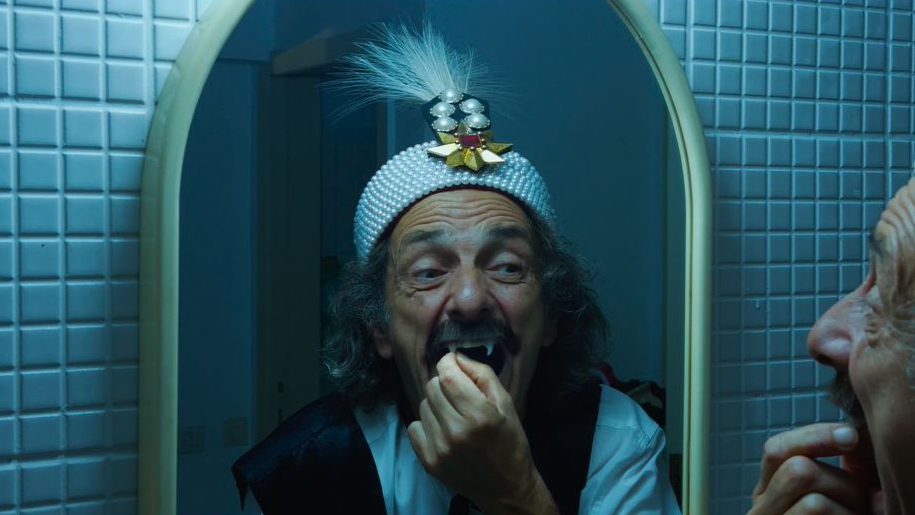
Although Count Dracula is rooted in the imagination of a 19th century Irish writer, he has long been appropriated as a quintessential Romanian persona—whether villain or hero, depending on one’s perspective.
Nestled in a castle within the Carpathian Mountains, this iconic vampire is inspired by a real-life historical figure known as Vlad the Impaler, whose methods of torture were far more gruesome than anything depicted in literature or film. Vlad hailed from Transylvania, a region in central Romania increasingly identified with bloodsucking lore, merchandise, and a plethora of pop culture references that span from lucrative Hollywood franchises to elaborate Halloween costumes.
Dracula
Lots of sucking, not a lot of blood.
It stands to reason that a prominent Romanian filmmaker would be drawn to explore the vampire mythos. Yet the outcome of this endeavor is anything but predictable: writer-director Radu Jude delivers a provocative and whimsical three-hour experience titled Dracula.
Like an extended Monty Python sketch pushed to its arthouse extremes, this film appears uniquely suited for devoted aficionados of Gothic narratives or ardent followers of the eclectic director, whose body of work spans various genres and themes—from political satires like Bad Luck Banging or Looney Porn to a stark black-and-white historical Western such as Aferim!.
In fact, Jude’s prolific output over the past decade includes another feature film—Kontinental ’25—which he produced concurrently, employing a similar cast and crew. That film’s acute social commentary on Romania’s deepening class divide resonated with audiences, offering a minimalist yet impactful lens on contemporary issues.
Conversely, Dracula suffers from an excess of ambition, feeling bloated and indulgent. It is characterized by a vulgar, childlike approach that suggests a creative choice to amalgamate multiple vampire narratives into a single cinematic experience.
As with his earlier works, Jude’s 170-minute odyssey is saturated with sharp political critiques, relentless humor, and a palpable air of Romanian fatalism. Nevertheless, its elongated runtime, haphazard construction (somewhat by design), and an overwhelming number of suggestive scenes, including simulated acts of fellatio, raise questions about its overall coherence. Jude’s audacity in venturing where few filmmakers dare to tread—even beyond the explorations of Warhol—might merit recognition, but viewer enjoyment remains a separate consideration.
The film unfolds over 14 chapters, all tethered by a shared theme of vampirism encompassing its myriad forms—literal, historical, political, metaphorical, and sexual. The narration is provided by a sarcastic fictional director (Adonis Tanta), a stand-in for Jude himself. Within the framework, Jude experiments with assorted genres, integrating elements of docudrama, satire, and even musical theater, encapsulating his ideas as though introducing horror flicks in a late-night television format.
This tapestry of narratives begins with an AI-generated montage, declaring, “I am Dracula and you can all suck my cock!” Such a line effectively sets the tone for the ensuing three hours, which are inundated with crude humor and risqué imagery. The culmination of this provocative tableau recounts the fable of a woman who uncovers magical phalluses sprouting in her cornfield—a narrative that allows local women to experience unimaginable pleasures.
Linking this extravagant tale to the overarching theme is tenuous, and at times, Jude’s message feels muddled amid the extensive material presented. He posits Dracula as a figure of extreme capitalist exploitation while simultaneously exploring how capitalists within the film and tourism sectors have commodified the immortal character. This notion is exemplified by references to a failed Dracula theme park project from the 1990s in Romania.
Contextualized within modernity, the film also features segments highlighting video game developers striking against their oppressive employer—depicted as a monstrous figure demanding compliance amid a zombie apocalypse. This narrative thread allows Jude to address contemporary social and political issues prevailing in Romania, critiquing racism and sexism embedded within the ruling class.
Additional storytelling, encircling a washed-up actor (Gabriel Spahiu) performing in a risqué theater for inebriated tourists, serves as commentary on Dracula’s evolution from a legendary figure to a beleaguered caricature forced to escape disgruntled admirers. However, the execution suffers from excessive slapstick, with tedious sequences reminiscent of the Benny Hill Show, broadcast through cheap visual aesthetics that mimic disposable media prevalent in social networks and streaming platforms.
Despite Jude’s earnest intentions to critique such visuals and explore societal exploitation, whether this ambitious commentary will resonate or endure seems improbable.
Based on reporting by Hollywood Reporter. Read the full story at Hollywood Reporter.