



Prior to the leadership of James Gunn and Peter Safran at the newly rebranded DC Studios, the television landscape of the DC Universe resembled a chaotic frontier. From Gotham on Fox to The CW’s Arrowverse, viewers were treated to a spectrum of shows characterized by varying tones and innovative takes on established mythos. Among these, Swamp Thing stands out as a series that did not receive the recognition it warranted, and it may very well be the most compatible entry from the past for the evolving DCU.
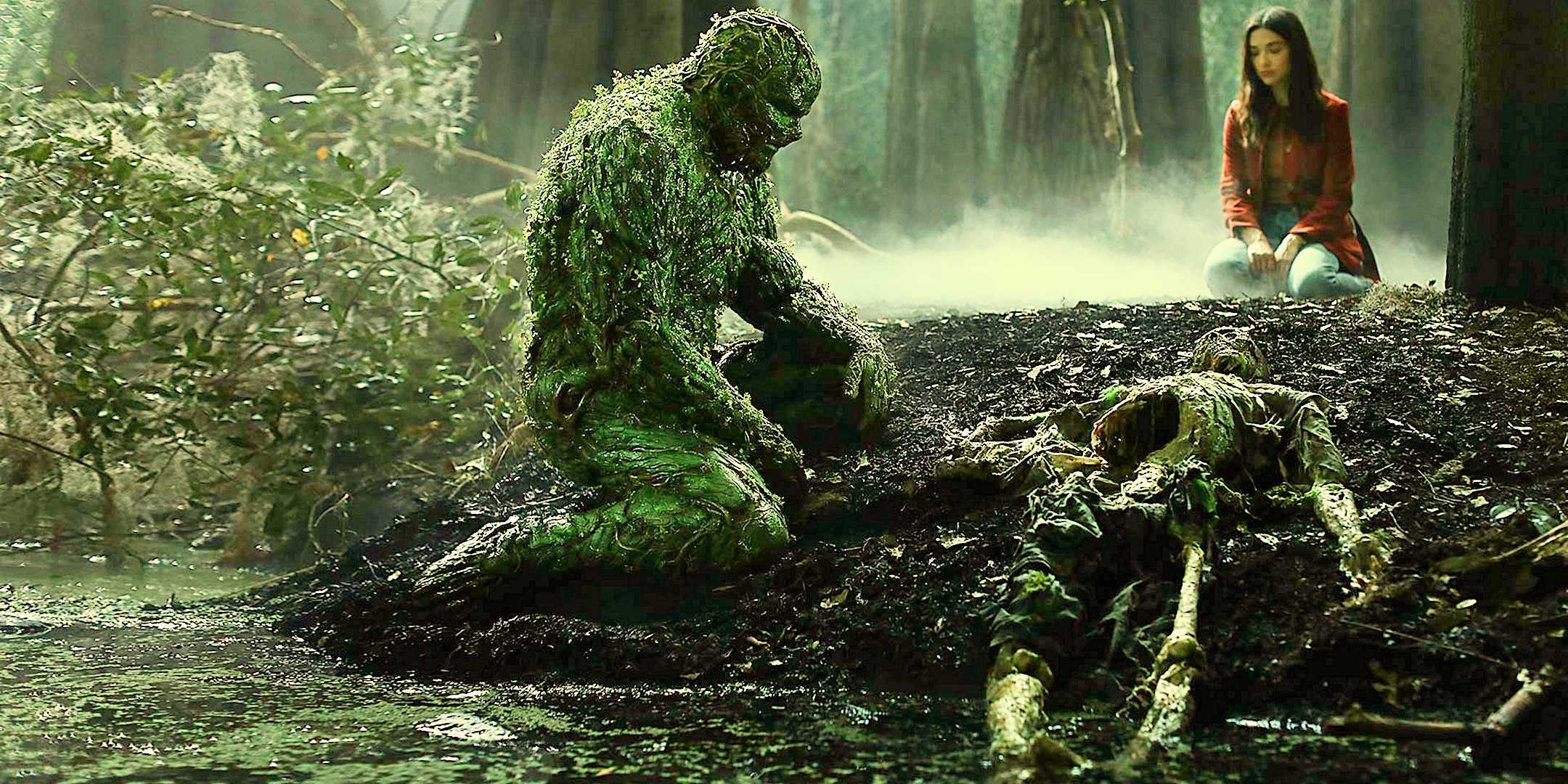
Created by Len Wein, Swamp Thing was conceived as a gothic horror figure indigenous to the woods. Yet, it was Alan Moore’s transformative work in the 1980s that redefined the character as a godly entity. Following a botched assassination attempt, Alec Holland metamorphosed into Swamp Thing, whose existence was revealed to be an avatar of the Green, imbued with Holland’s memories. This character has made appearances in two films during the 1980s, an animated miniseries in the 1990s, and a live-action show that spanned three seasons, all characterized by budget constraints. In stark contrast, the 2019 reboot of Swamp Thing brought forth a higher quality production, utilizing state-of-the-art digital effects while also presenting a fully functional practical suit for the titular character. Rumors abound concerning Swamp Thing’s future in the DCU; however, should plans falter, Gunn has a ready-made option in the ten-episode narrative that was already aired.
In 2019, DC kicked off its own streaming service, blending an extensive collection of digital comics, DC films, shows, and a roster of original series. Notable returns included Young Justice for its third season and the debut of the Harley Quinn animated series. The live-action segments featured Titans, Doom Patrol, and Stargirl, which also aired on The CW. Among these, Swamp Thing was the fourth installment and proved to be quite ambitious. It boasted a remarkable cast and filmed on meticulously designed sets that vividly captured the essence of swamp environments unattainable through location shooting.
The series took a methodical approach to storytelling, gradually developing characters such as Alec Holland, Abby Arcane, and other familiar faces from the comics. The narrative loosely adhered to Moore’s legendary run, culminating in the pivotal revelation that Swamp Thing was not Alec Holland. Additionally, the series delivered a chilling, comic-accurate portrayal of Jason Woodrue as the Floronic Man. While it was an authentic comic adaptation, it also thrived as a horror-drama, securing critical acclaim since its pandemic-era premiere on The CW, and achieving impressive ratings.
Unfortunately, Swamp Thing never had the opportunity to flourish. Warner Bros. initially commissioned thirteen episodes but curtailed the order to ten due to a lack of anticipated financial rebates from North Carolina. The original budget was an estimated $80 million, with expectations for a $40 million rebate that ultimately did not materialize, resulting in only $13 million in return. Compounding these financial troubles, the complexities of establishing and managing a streaming service soon became evident, leading to a corporate restructuring that transformed Warner Bros. into WarnerMedia, which later integrated DC Universe shows into HBO Max. Every title in that array secured at least one additional season, with the notable exception of Swamp Thing.
While recent entries such as Superman have laid the groundwork for a new era ostensibly rooted in comic book lore, the television series Creature Commandos and Peacemaker serve to further delineate it. These narratives collectively establish characters that transcend traditional human limitations, alongside introducing a multiverse filled with imps who pose significant threats across these realities.
In fact, a shared universe presents an ideal platform for the likes of Swamp Thing, whose themes, while somewhat surreal, are grounded in darkness and horror. Co-showrunner Mark Verheiden expressed optimism for what Gunn will unveil in this reimagined landscape, commenting on the transitional success and potential for a fresh narrative approach.
Upon its original airing, Swamp Thing was not part of the coherent DC shared universe popularized on The CW through Arrow. Rather, it carved its own niche, seamlessly integrating elements of science fiction and magic while remaining firmly anchored in a rural setting in Marais, Louisiana. The show featured compelling characters such as the demonic Blue Devil and deftly interwove horror motifs that resonate with the new DCU’s ambitions.
Interestingly, Swamp Thing might occupy a more strategic position within the DCU than even the inaugural season of Peacemaker. The latter’s narrative lacks references to adjacent heroes, allowing for greater narrative flexibility. Given that the series primarily serves as an origin story, it could easily integrate into future plans without necessitating extensive canonical adjustments.
Prominent filmmaker James Mangold had previously expressed willingness to direct a Swamp Thing film. Interestingly, Mangold has been skeptical about shared cinematic universes. Despite that, Gunn had mentioned the film in his preliminary public presentation for the “Gods and Monsters” segment of the DCU—with writer Beau Willimon stepping in as a co-writer. Nevertheless, production remains elusive, casting doubts over whether the project will materialize anytime soon.

As of this writing, three films remain uncommenced: Batman: The Brave and the Bold, The Authority, and Swamp Thing. Recent interviews revealed that certain ambitious projects have been stalled due to script discrepancies, although specific titles remained unnamed. While Gunn has expressed confidence regarding the continuance of Batman and The Authority, Swamp Thing remains in pre-production—a gap that might ultimately see Clayface emerge as the DCU’s focal horror project instead.
Despite Mangold’s undeniable talent, his artistic vision appears misaligned with Gunn’s direction for expansive comic storytelling. Given Swamp Thing’s critical role as the avatar of the Green, his integration into the DCU seems imperative. Furthermore, Gunn’s demonstrated aversion to traditional origin stories posits that Swamp Thing effectively concludes with a satisfying premise for continuation, allowing new audiences to conveniently explore the character’s backstory through the series.
The most recent updates indicate that Mangold’s iteration of Swamp Thing remains in pre-production, while the complete series is accessible for streaming on HBO Max.
Based on reporting by CBR.com. Read the full story at CBR.com.