
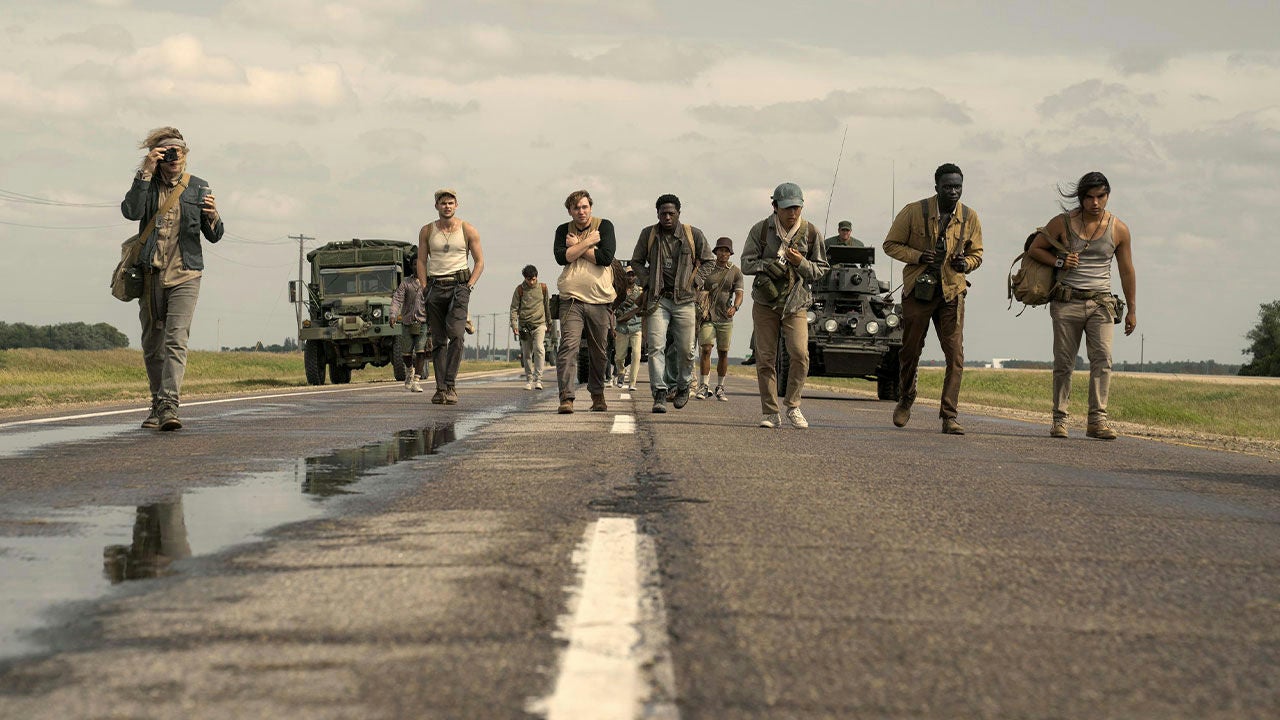
While it may not have been the first book penned by the Master of Horror, The Long Walk holds the distinction of being the first novel Stephen King ever wrote. Crafted during the tumultuous period of the Vietnam War, it serves as an intriguing, primal text for deciphering the perspectives that shape King’s worldview. Its themes remain remarkably resonant today, a fact adeptly captured in the long-awaited adaptation directed by Francis Lawrence and written by JT Mollner, which elevates the film beyond the seemingly simple premise.
The rules governing the fifty young men fortunate enough to be drawn in a nationwide lottery for The Long Walk are starkly straightforward: walk. Do not stop, do not sleep—walk. A contestant who falls below three miles per hour, interferes with another participant, or otherwise violates the regulations receives a warning. Three warnings culminate in the grim fate of “getting your ticket,” a euphemism for a bullet to the head delivered by the military escort accompanying them, led by The Major (Mark Hamill), a caricature of machismo and rugged individualism who embodies a god-like authority within this fractured universe.
As the Walk progresses and the adversities presented by the environment and the frailties of the human body intensify, the allure of that bullet becomes increasingly appealing for the beleaguered young men. Lawrence, known for his work in dystopian narratives such as I Am Legend and the Hunger Games series, initiates the Walk almost immediately, yet skillfully delays the first elimination, a moment adorned with cinematic flair that catches audiences by surprise well into the film. Each drop of rain, elevation, ration shortage, and bodily function becomes a crucial component affecting the march’s life-or-death stakes.
The film depicts the numerous fatalities throughout The Long Walk in a stark and unflinching manner. By the narrative’s conclusion, those who “got their tickets” early on appear to be the true victors of this grim lottery. Lawrence keeps viewers immersed in the harrowing experience, extracting every ounce of shock from the R-rating and rendering the audience complicit in the unfolding violence. Even in the absence of visible carnage, the camera lingers on the expressions of the terrified survivors, allowing the mounting psychological burden they bear to resonate profoundly. The violence quickly becomes numbing, a technique that Lawrence highlights through a poignant moment when Cooper Hoffman’s Ray Garraty articulates the chilling reality that both the Walkers and the audience (in their world and our own) risk becoming desensitized to the bloodshed. The simplicity of The Long Walk’s premise proves to be remarkably versatile, accommodating reflections on various societal challenges.
Garraty’s motivations for participating in the Walk—and the significance of victory to him—are far more intricate than those of many of his fellow competitors. This complexity enables him to forge connections with other Walkers, notably with Peter McVries (David Jonsson). The dynamic between Garraty and McVries provides a reflective exploration of the existential quandaries posed by the competition, with both Hoffman’s and Jonsson’s performances embodying a naturalism that provides a glimmer of hope amid the pervasive darkness. Their mutual support and kindness become contagious, leading to small yet profound moments of victory, whether it’s through sharing food or offering physical support to one another.
The relationship dynamics between Garraty and McVries illustrate the tension in their efforts to preserve camaraderie amid the relentless exhaustion they both face. This connection emerges as instrumental for survival, even though the rules dictate that only one contestant can prevail. With Garraty’s aspirations for how the world could transform with his victory, McVries emerges as the emotional center of the film, emphasizing the importance of living in the moment and finding silver linings amidst adversity—even as the rain-soaked challenges threaten to break down their resolve.
Unfortunately, the supporting cast of fellow contestants lacks similar depth, leaving Lawrence and Mollner grappling with how much narrative investment to allocate to characters with inevitably short arcs. More prominent figures like Olson (Ben Wang) and Baker (Tut Nyuot), who reflect Garraty’s and McVries’ optimism, largely serve to reinforce the protagonists’ viewpoints. Barkovitch (Charlie Plummer) represents a genuine antagonist, a nervous nihilist positioned to disrupt the morale of the group; however, the film doesn’t quite capitalize on his potential. Garrett Wareing’s Stebbins, a quiet yet formidable contender, offers unique insights that underscore the despair that permeates the competition. Mark Hamill’s portrayal of The Major tends to lack depth, and his privileged position of being transported while young men march to their fate serves to highlight the broader commentary of The Long Walk.
Running at a compact 108 minutes, The Long Walk still manages to feel prolonged. While the repeated cycle of fatalities carries emotional weight, the pacing in the latter half of the film sometimes drags, leaving one to ponder if trimming even a few minutes could enhance the overall impact. Despite the stunning natural landscapes captured on screen, Lawrence faces a challenge in maintaining visual variety through the lengthy scenes of the Walk. He effectively alternates the monotony with poignant flashbacks introducing Ray’s home life, shedding light on his motivations for participating. These narrative deviations are not merely detractors from King’s original material; instead, they add depth while respecting the essence of the story rather than altering it for superficial reasons.
Though the narrative primarily centers on the Walkers, Judy Greer’s Ginny Garraty makes compelling brief appearances that capture the emotional turmoil faced by a mother watching her son participate in this deadly competition. Greer adeptly conveys a spectrum of emotions that serve to underscore the film’s emotional stakes, her presence hauntingly bookending the story in a manner that rivals the film’s more graphic moments.
Based on reporting by Tom Jorgensen. Read the full story at https://www.ign.com/articles/the-long-walk-review