
Throughout the 1990s, a number of notable comic book adaptations emerged, many of which were regrettably overlooked. Among them, only a select few incorporated an early 20th-century setting, capturing the essence of the era’s darker superhero narratives. One film in particular stands out as a significant illustration of this trend, serving as a direct adaptation of one of the seminal works of that period. This film, often regarded as one of Alec Baldwin’s more underappreciated roles, is The Shadow.
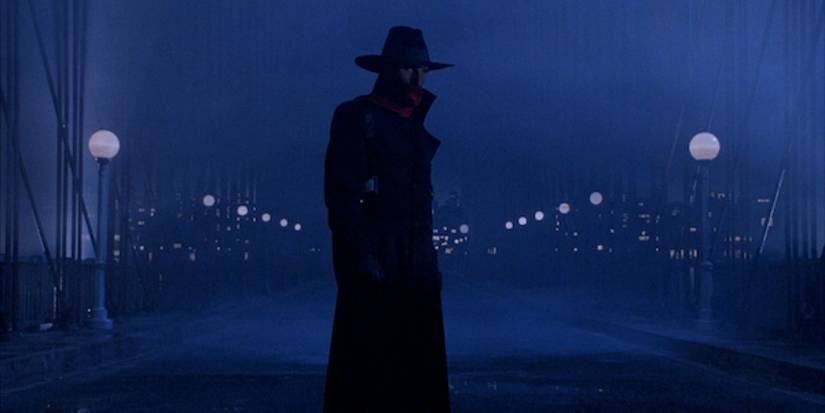
The film draws inspiration from the legendary comic book character, created in 1930 by Walter B. Gibson, who originally served as the enigmatic host of the radio program Detective Story Hour before evolving into a formidable symbol of justice in his own pulp magazine series. The character later appeared in various audio dramas and short films throughout the 1930s, ’40s, and ’50s, yet the portrayal by Baldwin remains the most recognized among contemporary audiences. Despite its creation during a time when comic book films were starting to gain traction, The Shadow suffered from a lukewarm critical reception, receiving only a 37% approval rating on Rotten Tomatoes and grossing $48 million worldwide against a $40 million budget, leading it to fade into relative obscurity.
Released in 1994 and helmed by Australian director Russell Mulcahy, famed for Highlander, and screenwriter David Koepp, who was then best known for his work on Jurassic Park, The Shadow tells the story of Lamont Cranston, an American who becomes a ruthless drug lord in post-World War I Tibet.
Cranston’s life takes a significant turn when he is conscripted as a student to a holy man named Tulku, who imparts to him the ability to manipulate the minds of others, making him nearly invisible apart from his shadow. Upon returning to New York City, Cranston employs these extraordinary abilities to combat the forces of evil.
Similar to other overlooked 90s comic book adaptations like The Rocketeer, which honors the classic action-adventure serials with an authentic recreation of their aesthetic, The Shadow goes beyond mere homage; it revives the essence of noir fiction that defined the original adventures of its titular hero.
From its meticulous production design, which reconstructs 1930s New York through a harmonious blend of full-scale sets on the Universal Studios backlot, matte paintings, and strategic computer enhancements, to its opulent costuming, the film is visually striking. While some critiques highlight a disparity between the film’s earnest suspense and its moments of overt humor, the comedic elements resonate well, resulting in an undeniably entertaining superhero narrative.
In 2025, during an appearance on his brother Stephen Baldwin’s podcast, One Bad Movie, Alec Baldwin reminisced about his missed opportunity to portray the titular character in the 1989 blockbuster Batman, a role that ultimately went to his Beetlejuice co-star, Michael Keaton. Baldwin learned from his then-wife Kim Basinger, who portrayed Vicki Vale in the DC Comics adaptation, that director Tim Burton was searching for an actor who could portray Bruce Wayne as a troubled soul, leading him to believe Baldwin was not suited for that interpretation. Nevertheless, Baldwin’s performance in The Shadow suggests that Burton may have underestimated his capabilities.
As an Academy Award nominee, Baldwin captures the complex duality of Lamont Cranston, balancing the persona of a carefree playboy outside his vigilante alter ego. He displays his trademark comedic charm while genuinely embodying a man seeking redemption for his past misdeeds.
Furthermore, The Shadow is one of several pulp fiction characters that influenced Batman, who would later collaborate with Baldwin’s character in a comic series. It’s evident that Baldwin fulfilled his aspirations of participating in a comic book adaptation.
While many iconic hero-villain pairs, such as Batman and The Joker or Superman and Lex Luthor, showcase their differences in personality and abilities, The Shadow presents a unique dynamic with its antagonist, Shiwan Khan. Originating from Walter Gibson’s 1939 pulp novel, The Golden Master, Shiwan Khan, portrayed by John Lone, surfaces as a formidable opponent capable of rivaling The Shadow due to their shared training under Tulku.
Khan initially approaches Cranston, seeking to enlist him in his sinister ambitions to dominate the world, aligning his aspirations with those of his ancestor, Genghis Khan. Their acknowledgment of one another as equals adds a layer of complexity to their rivalry, fostering mutual respect and enriching the narrative.
The commercial failure of The Shadow is disappointing, particularly considering how many audiences overlooked a film that not only excels as a traditional, noir-inspired comic book adaptation but also showcases superb performances from a talented ensemble. Alongside Baldwin, John Lone delivers a captivating blend of menace and self-righteousness that makes Shiwan Khan one of the most underrated comic book villains of his time.
Penelope Ann Miller shines as Margo Lane, offering an irresistible 1930s flair as Cranston’s love interest, who proves to be Cranston’s equal, displaying immunity to his mind-altering powers and possessing her own telepathic abilities. Ian McKellen provides a delightfully humorous portrayal of Margo’s father, Dr. Reinhardt Lane, while Peter Boyle, shortly before his notable role in Everybody Loves Raymond, captures the essence of a loyal ally as cab driver Moe. Meanwhile, Tim Curry delivers an unforgettable performance as Farley Claymore, Dr. Lane’s assistant, adding a comedic touch that remains compelling throughout the film.
One of the more regrettable unrealized projects surrounding The Shadow is Sam Raimi’s proposed reboot announced in 2006, which aimed to revitalize the classic pulp hero with Michael Uslan. Unfortunately, the project was ultimately shelved due to a lack of a suitable script.
However, fans may rejoice at the existence of a modern adaptation that honors the original character. Despite the mixed reception and lasting legacy of the 1994 film, recognized as one of the most underrated comic book movies of all time, it indeed warrants further consideration and a potential rewatch. At the very least, The Shadow is aware of its own merits.
Based on reporting by CBR.com. Read the full story at CBR’s retrospective on The Shadow.